Cubavera’s linen category contains an easy comparison trap: regular, stretch and flat front sound like three competing fit levels, but they describe different things. Regular refers to a fit label, stretch refers to a fabric claim, and flat front describes the presentation of the trouser front. Reading them as a single scale can steer you toward a pair that does not answer your real question.
The three catalog listings here offer two drawstring routes and one flat-front dress-trouser route. A useful choice begins by deciding which garment feature you need, then checking what the selected listing actually establishes about it.
Quick Answer
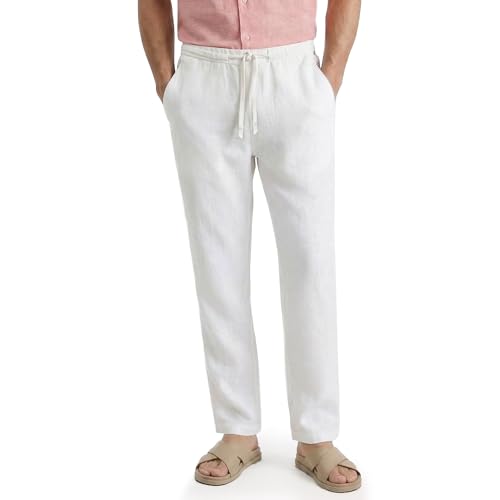
Choose the regular linen-blend drawstring listing when an adjustable casual waist is your priority. Investigate the stretch drawstring listing when a stated stretch-fabric feature matters, while checking its actual fit and composition. Choose the flat-front dress pant for a more dressed front. All three titles identify linen blends; none supplies enough information to rank cooling, durability or wrinkle resistance against the others.
As an Amazon Associate I earn from qualifying purchases.
Put the three descriptions on separate axes
A waistband can adjust without the leg fabric stretching. A trouser can have a flat front and still be described as regular fit. A stretch-fabric claim does not tell you whether the rise is high, whether the thigh is narrow, or how much the waistband expands. These are separate properties, and you may care about more than one.
Write down the reason you are dissatisfied with your current pants. If the waist feels restrictive after sitting down to a meal, a closure or waist construction may be central. If the thighs pull while you climb a step, the cut and garment dimensions deserve attention. If the front looks too informal for your intended outfit, the flat-front dress model addresses a different concern again.
That diagnosis helps avoid spending the comparison on vague comfort language. “I need more room in the upper leg” can be checked with measurements. “I want the best Cubavera pants” cannot be answered responsibly from the three titles alone.
The short catalog ledger
| Exact option | Positive information in the title | What it does not settle |
|---|---|---|
| Regular linen-blend drawstring pants | Regular wording, drawstring and a listed size-range description | Fabric stretch, waist travel and exact leg dimensions |
| Stretch linen-blend drawstring pants | Drawstring and an explicit stretch-fabric description | Amount, direction or recovery of stretch; exact blend percentages |
| Flat-front linen-blend dress pants | Flat front, dress-pant format and regular fit | Detailed closure construction, belt-loop arrangement and event suitability |
The regular drawstring product is not automatically a nonstretch garment just because stretch is omitted from its title. The stretch drawstring product has a more explicit claim on that point, but we do not have a measured comparison of the two.
The flat-front dress-pant option shares linen-blend and regular-fit language with parts of the other listings. Shared wording does not establish a common pattern, fabric or size chart. Assess it as a separate garment rather than a drawstring pair with the cord removed.
Branch one: the waist is the feature you need
If you want the visible drawstring treatment, begin with the regular listing and examine its actual waistband. Check how the pants go on, how the adjustment works and whether the chart gives body or finished-garment dimensions. A cord can secure a waist without correcting excessive room elsewhere, so do not buy a much larger pair solely because you can tighten it.
Try a tucked and an untucked top if both are part of your routine. The amount of fabric at the waist changes when a shirt is tucked in. Decide whether the drawstring should be visible as part of the style or simply functional beneath the top. A relaxed outfit often leaves room for either approach, but the proportions should be deliberate.
This route is especially relevant if your trouser problem is everyday adjustability rather than a need for stretch in the leg cloth. It keeps the decision focused: does the actual waist work for you, and do the seat and thigh provide enough space without depending on the cord to hold up an oversized garment?
Branch two: you want fabric movement as well
The stretch drawstring listing becomes interesting when the cloth’s ability to give is a specific selection criterion. Its title supports looking further into that feature. It does not tell us a stretch percentage, identify the stretch direction, or establish how well the fabric returns after repeated movement.
Read the complete composition and any supplied garment measurements. An elastic waistband and a stretch-fabric claim can both appear in shopping language, but they should not be substituted for one another. Our stretch and bagging guide distinguishes temporary fabric growth from dependable elasticity and recovery.
During a fitting, move without forcing the cloth to compensate for an unsuitable size. Sit, step up and return to standing. If the waist is correct but the upper leg strains, investigate another size or shape rather than assuming a stretch claim makes that strain harmless. Clothing that yields under tension is not necessarily clothing whose proportions suit you.
For someone who prefers a close-looking silhouette, stretch may be an appealing feature to research. However, the title of this model does not establish a slim cut. Start with its own measurements and photographs; do not import the appearance of unrelated stretch chinos into the comparison.
Branch three: you want a more composed front
The flat-front dress trouser is the more direct starting point for an outfit built around a tucked shirt or a jacket. That is an interpretation of its described format, not a claim that the other two cannot be worn neatly. It lets you focus on front presentation instead of choosing between two drawstring variants that share a casual cue.
Look at how the shirt, waistband and jacket meet. A front can appear clean when standing yet become crowded by an overly bulky tucked shirt. Check the pocket area after sitting as well; a model name cannot tell you whether its rise and seat suit your posture. Choose the fit that remains acceptable in use rather than optimizing only the initial mirror pose.
For wedding use, clarify the event’s requirements before buying. Linen-blend dress pants may fit one celebration and be inappropriate for another. The wedding guest guide covers that decision. Neither the fabric name nor the word dress replaces an instruction to wear a specific type of outfit.
A three-person example without a universal winner
Consider three fictional shoppers. One wears loose untucked shirts and likes adjusting the waist over the course of a day. The regular drawstring model is the logical first inspection. Another already wants a drawstring but specifically values a fabric-stretch claim; that shopper should investigate the stretch version’s full details. The third needs trousers under a blazer and dislikes visible cords, so starts with the flat-front pair.
Their decisions can diverge again at the size chart. The first shopper may find that the stretch model has the more suitable dimensions. The blazer wearer may reject the dress pair because the available length does not work. A sensible shortlist is a starting hypothesis, not an obligation to purchase the garment whose name sounded right initially.
Use the same approach with your own shortlist: name the task first, then compare the measurements that control it. If two models both satisfy the task, the remaining choice may be a waist detail, an available color or which pair already works with your shoes. Keep those preferences separate so you can see why one option wins for you.
Finish with variant and wardrobe checks
The current catalog titles show different example sizes and colors. They are not a coordinated comparison set photographed in one size, so apparent shape differences in product imagery may have several causes. Open the size and color you intend to buy and verify its details rather than relying on the example variant embedded in the title.
Then compare the garment with the shoes and tops you already own. A dress trouser that needs different shoes, hemming and a new shirt is a different wardrobe commitment from a pair that integrates immediately. Conversely, buying a casual drawstring pair because it requires fewer new items may miss the formal gap you were trying to fill.
Make a final note of which point remains unresolved. If it is the stretch behavior, seek product-specific information. If it is the waist construction, inspect the detailed images or ask about it. If it is material content, use the full label. The label-reading guide helps keep blend names and actual fiber disclosures separate.
FAQs
Is the regular drawstring pair definitely less stretchy than the stretch version?
That comparison is not established. One title explicitly describes stretch fabric and the other does not, but omission is not proof of absence. Use the fuller listing information or a direct model-specific answer before assuming a measurable difference between them.
Does flat front mean the dress pants have a slim fit?
No. Flat front describes the front presentation, while this dress-pant title separately says regular fit. The waist, seat and leg measurements determine how close the trousers feel on you. Do not select them as a slim model merely because the front sounds less gathered.
Are all three Cubavera options pure linen?
No pure-linen claim is established here. Each title identifies a linen blend, and these title records do not identify every companion fiber or percentage. If a 100% linen composition is essential to your purchase, these descriptions are not enough to satisfy that requirement.
Can I compare the sample waist and inseam printed in each title?
Those numbers belong to example variants, not necessarily the full selection or identical size systems across the products. Choose your intended variant first and read the associated chart. A letter size on one listing and a numeric waist on another need a measurement-based comparison.
Final Verdict
Use this comparison as three routes into the catalog: waist adjustability, an explicit stretch-fabric feature, or flat-front dress styling. Start with the route that addresses your actual need, then let the dimensions and complete garment details confirm or change the choice.
The regular drawstring model is not a baseline that every other pair automatically improves on. The stretch and dress options address additional or different priorities. A well-chosen Cubavera pair is the one whose specific construction and proportions support your outfit, without borrowing unverified benefits from the other two.