A top can be lovely on its own and still feel awkward above linen pants. Usually the problem is a meeting point: the shirt ends at the fullest part of a pocket, a gathered waist competes with a bulky tuck, or two long shapes leave no visible break. You do not need to replace the whole outfit. Change one of those relationships first.
This guide works from the trousers upward, using top length, shape and detail to build everyday outfits. These are styling choices, not rules about which bodies should wear which clothes.
Quick Answer
Choose a top by where its hem meets your pants and how much volume you want overall. A short boxy shirt, a fluid tucked blouse or a long open layer can each work with wide legs. Keep bulky fabric away from a gathered waistband when that area feels crowded. Test the outfit sitting and walking before deciding that it needs a belt or a different size.
As an Amazon Associate I earn from qualifying purchases.
Find the point where the outfit becomes crowded
Put on the pants and the top you already wanted to wear. Look at the front, then turn sideways. Identify the particular area you dislike rather than deciding the whole silhouette is wrong. Is the blouse pooling above the waist? Does a shirt tail cover half a pocket? Is the top's lower edge catching on the hips instead of falling freely? Each problem suggests a different adjustment.
A small front tuck can shorten the visible top without removing all its ease. Rolling a shirt sleeve changes the amount of fabric around the upper body without touching the waist. Opening a few shirt buttons over an appropriate base layer creates another line. Try these changes separately; if you make all three together, you cannot tell which one helped.
Sometimes the answer is simply to leave a loose top loose. An oversized shirt over wide pants creates an intentionally roomy outline. If that is what you want, choose it deliberately. A visible neckline, an open cuff or a clean shirt hem can give the combination definition without forcing a waistline into view.
Three waistband situations that change the top
A visible drawstring
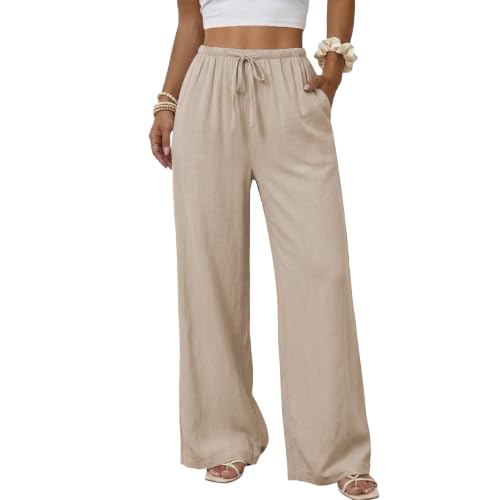
A drawstring is already a detail at the center of an outfit. Above it, a plain tee or simple knit gives the eye somewhere quieter to rest. If the bow hangs below a top hem, decide whether that overlap looks intentional to you. You might prefer a shorter top that exposes the whole closure, or a longer untucked one that covers it completely.
Duyang's cotton-linen palazzo listing explicitly names a drawstring elastic waist, wide leg and pockets. Compare a tee ending near the upper hip with a lightly tucked shirt, checking how each hem sits around the advertised tie. The exact result depends on the top and selected trouser measurements, so use the drawstring as a verified detail to arrange rather than a fit guarantee.
A gathered or smocked waist
Tucking thick fabric into gathers can create more bulk than you expected. A thin blouse may be easier to arrange than a heavy sweatshirt, but the goal is not to compress yourself into the waistband. Leave enough room to sit. If the top bunches again as soon as you move, use a clean untucked hem instead of continually readjusting it.
Roxy Oceanside is listed with an elastic drawstring waist. A short relaxed shirt or a tank with an open overshirt is a plausible pairing for that casual construction. Neither requires a belt. Do not assume belt loops exist simply because a styling photograph shows a belted outfit elsewhere.
A button-front waist you want to show
A fixed-looking front can act as the organizing line of an outfit. Hooever's cotton-linen trousers are described as button-up, high-waisted and wide-leg. A tucked blouse makes those advertised front details visible, while a straight short top can leave the upper waistband largely unobstructed. Check the actual closure and fit before choosing between them.
Match the top's length to the job you need it to do
| Top length | What it can do | What to check |
|---|---|---|
| Ends around the waistband | Shows the trouser shape without a tuck | Coverage when reaching or sitting |
| Ends around the upper hip | Offers an easy everyday middle ground | Whether the hem catches on pockets |
| Long shirt or tunic | Creates a continuous relaxed line | Side openings and room through the seat |
| Open overshirt | Frames a simpler base layer | Whether both layers bunch at the back |
These are positions on your own body, not universal inch measurements. The same shirt can act like a long tunic on one person and a waist-length layer on another. Photograph the actual combination if the mirror angle makes proportions difficult to judge. A long mirror view is more useful than a close photograph of the waistband alone.
For cropped trousers, a long top can move most of the visible detail toward the bottom of the outfit. If that feels unbalanced, try shortening the top before blaming the cropped pants. With full-length wide legs, a short top can provide a clearer interruption between the two large areas of fabric.
Build four outfits from different starting points
The tee you wear repeatedly
Start with your preferred tee, not a newly purchased top. With wide linen pants, check its shoulder width and hem together. A broad tee with a tight lower band may balloon above the waist; a straighter tee can fall differently even in the same labeled size. Try the straight hem loose, then a shallow front tuck. Add only the accessories that you already find useful.
If the tee has a large graphic, keep the waistband area simple so the graphic and a cluster of ties do not compete. If the tee is plain, a visible drawstring can supply enough detail. This is a way to organize attention, not a rule requiring minimalist clothing.
The button-down that feels too long
Use the shirt open over a base layer and see whether its length now looks purposeful. Alternatively, tuck it fully and gently release enough fabric to move your shoulders comfortably. A half tuck can work, but inspect the back: a tight front combined with a bunched tail may be the actual source of the awkwardness.
Do not automatically tie a knot in a delicate or closely fitted shirt. A knot changes where tension falls and may leave less room than a normal tuck. If tying is your preferred look, start with a shirt that has enough spare length and check that the buttons are not being pulled sideways.
The soft blouse with a full sleeve
A full sleeve plus wide trousers can be expressive and balanced through repetition. It does not need a narrow leg by default. Consider keeping the blouse torso simpler, opening the neckline to your preference, or exposing the waistband. Choose one clear organizing detail instead of treating every full area as a problem to eliminate.
The knitted tank and light layer
A tank under an open shirt lets you vary coverage without changing pants. The useful check is whether the tank remains in place when the overshirt moves. A long tank that bunches beneath the trouser waist can undo the otherwise clean front. Try a different tank length before adding another accessory.
Decide whether a belt adds anything
A belt can mark the meeting point between top and trousers, carry a repeated color, or make an exposed closure look more finished. It is not compulsory with a tuck. First confirm that the pants have appropriate loops and that the belt fits those loops. Trying to secure an unsuitable waistband with a decorative belt can create uneven gathers.
Match the belt to the visual emphasis you want. A low-contrast belt makes a smaller interruption; a contrasting one makes the waist a focal point. Neither choice is inherently better. If a blouse already has prominent buttons, a neck tie and a print, you may prefer to let its details lead.
Give the finished combination a movement check
Reach forward, sit and stand, then walk a short distance. A top that immediately escapes its tuck may need more length, more trouser room or an untucked styling choice. Constantly retucking is information about the pairing. It does not prove the pants should be smaller or the top tighter.
For the underlying trouser diagnosis, use the linen pants fit guide. If the top works but the outfit still feels unfinished at ground level, continue with footwear and hem pairings. Keep those decisions separate so you can identify the adjustment that actually improves your outfit.
FAQs
Can I wear a loose blouse with wide linen trousers?
Yes. Keep the generous silhouette if you enjoy it. You can create definition through a clear neckline, a visible cuff or the blouse hem rather than making the blouse fitted. Check that the blouse falls freely instead of catching on the pockets.
Does every high-waisted pair need a cropped top?
No. A tucked longer shirt can reveal the same waistband, and an untucked top can intentionally cover it. Choose based on coverage and movement as well as appearance. The high rise describes the trousers, not an obligation to expose their upper edge.
What if my front tuck looks good but the back balloons?
Release the front slightly and redistribute the shirt around the sides. If the back still collects fabric, compare a full tuck with a fully untucked hem. Some shirt lengths and trouser rises simply do not cooperate with a partial tuck.
Final Verdict
Choose your top by solving the specific meeting point between its hem and the pants. For a simple starting outfit, use a familiar tee or shirt and adjust only the tuck or visible length. Keep a belt optional. Once the combination stays comfortable through ordinary movement, it has done more useful work than any rigid rule about balancing wide legs.