A thin pair can feel restrictive if it clings across the thighs. A roomy pair can still contain a lining you did not expect. Shopping for hot-weather linen pants means looking past the fiber name to the complete garment you will wear.
The most useful comparison is between actual constructions: how much room the cut provides, how the layers are arranged and whether the coverage meets your needs. Linen offers a material starting point, but it cannot promise that a particular person will feel cool in every humid setting.
Quick Answer
Choose hot-weather linen pants by the combined effect of cloth, cut, lining and your intended activity. Look for enough movement room, manageable hems and verified coverage rather than assuming thinner or 100% linen is always better. Check the exact composition and any lining information. No listing in our catalog establishes a cooling temperature, guaranteed sweat control, rated sun protection or medical heat protection.
As an Amazon Associate I earn from qualifying purchases.
Separate the fiber from the garment around it
A title saying 100% linen identifies a fiber claim; it does not describe every variable affecting the finished trousers. The same fiber can appear in different weights, weaves and garment shapes. A densely woven structured trouser and a light, loose pant can therefore serve different preferences despite sharing a composition label.
Blends add another question: what fibers, in what proportions, and in which part of the garment? A linen-blend title without percentages is incomplete evidence. It is still a legitimate shopping lead, but it should not be translated into a claim that the fabric behaves like pure linen or has a particular amount of stretch.
Read the listing as a set of separate fields. Composition answers what the cloth is made from. Construction answers how it is arranged. Fit describes the relationship to your body. A useful purchase requires those answers to work together; a favorable word in one field does not cancel a problem in another.
What textile research can and cannot tell a shopper
The CETELOR 2014 study overview, published through the Alliance for European Flax-Linen & Hemp, compared four representative pure-fiber samples: linen, cotton, polyester and viscose. They were comparable knitted samples made on the same gauge machine. The work examined properties including ventilation, water-vapor resistance, absorption and heat retention.
That is a useful reminder that textile properties can be investigated under defined conditions. It is not a wear test of the Amazon trousers on this site. It did not compare their woven fabrics, waistbands, pocket bags, linings or complete outfits. We therefore do not convert it into a universal ranking of pants or a promise about degrees of cooling.
For a shopping decision, treat a broad material preference as the start of a shortlist. The next step is to examine the actual garment and your use case. A scientific result on a controlled sample cannot fill missing product specifications.
Consider room around the upper leg before chasing maximum width
During a try-on, pay attention to the seat and upper thigh while sitting and walking. A pant can have a wide hem but remain close through the top block. If that area feels restrictive, more fabric at the ankle does not solve the problem. Compare a different size or a cut with the needed room in the relevant place.
At the other extreme, maximum volume is not automatically practical. Very long palazzo hems may need managing around pavement, steps or low footwear. The aim is a comfortable amount of space with a length that works for the day's movements. Someone spending the day seated may choose differently from someone repeatedly walking outdoors.
The waistband deserves separate attention. An adjustable cord may help fine-tune circumference, while a broad elastic section may feel different under a tucked top. Neither tells us whether the leg fabric stretches. Keep the closure decision separate from any assumption that the whole garment will expand during movement.
Three listings show why the layer question matters
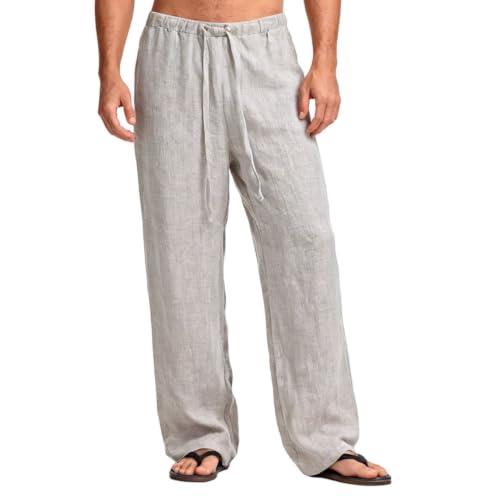
Amazhiyu's men's loose drawstring pants explicitly claim 100% linen in the title and use an elastic drawstring construction. That is a relevant starting point for a shopper who wants pure-linen wording and a relaxed waist. It does not establish fabric weight, an absence of lining or measured hot-weather performance.
maamgic's men's 100% linen pants explicitly mention a built-in liner. That detail deserves attention when comparing them with other pure-linen listings. Ask about the liner's coverage, composition and attachment rather than assuming that a liner is either universally helpful or universally unsuitable in heat. It may address a coverage preference while adding a layer you need to evaluate.
For a wide women's silhouette, Faleave's cotton-linen palazzo listing provides a blend-based alternative. The title names cotton and linen but does not provide a verified ratio. Comparing it with a pure-linen listing is a choice between actual garments, not an opportunity to declare every blend warmer or every all-linen pant cooler.
Coverage can be the limiting factor
If a light garment does not provide the coverage you want, buying it for its apparent thinness may simply lead to adding more underlayers. Consider that complete combination before purchasing. A slightly different cloth or a deliberately lined construction may be a better practical choice than an unexpectedly sheer pair that needs an improvised solution.
Check light colors under relevant lighting and with the underlayers you intend to wear. Fabric tension can change what you see when sitting or bending. Do not assume that a pale product photographed against a white studio background will behave the same way outdoors. Our opacity guide owns the detailed coverage checks.
Darkness alone also does not establish a complete answer. A dark pair may meet your visual preference but still have a weave or fit you dislike. Compare color, coverage and construction individually rather than using one as a shortcut for all three.
Match the choice to a specific hot-weather day
Mostly indoors with short outdoor transitions
If most of the day is spent in a cooled building, choose trousers that work indoors and add or remove an upper layer as needed. The lightest possible cloth may not be your preferred all-day garment. Consider the office or venue's appearance expectations alongside the brief warm commute.
Slow outdoor errands with frequent sitting
Prioritize a waistband and rise that remain comfortable through repeated transitions between walking and chairs. Check pocket bulk with the items you actually carry. A relaxed straight leg can be as relevant as a wide leg when the upper-leg fit is right.
A social event outdoors
Coverage, footwear and the event's required outfit level may narrow the choice more than composition does. Select a pair that meets those needs, and do not rely on ordinary clothing as a solution to heat-related health risks. The garment decision is about everyday wear preference, not a protective performance claim.
Use reviews and listing adjectives as questions to verify
Words such as breathable, cooling and lightweight can describe a seller's positioning without giving a test method or a comparable measurement. If a listing provides a specific fabric weight, that can be useful, but it still does not establish how the complete garment feels on you. If no weight is given, do not invent one from the photograph.
A review reporting comfort on one trip describes that person's experience with a particular variation and conditions. It can prompt a useful question about fit or lining, but it is not a guarantee for your size, color or day. Look for repeatable details you can check, such as whether the reviewer identifies a visible lining or a measurement, while keeping their subjective result separate.
Make a short list of unresolved questions before ordering: exact composition, liner details, relevant garment dimensions and care. If the most important answer remains unavailable, compare another listing. You do not need to accept missing information simply because the headline contains the word summer.
Decide which compromise you can live with
Everyday clothing involves tradeoffs. You may prefer more coverage even if it means another layer, or a looser silhouette even if it requires careful hemming. You may choose a blend because its specific shape suits you better than the available pure-linen options. None of those choices contradicts a thoughtful hot-weather wardrobe.
What matters is naming the compromise before purchase. If you require both substantial coverage and the least possible layering, compare that complete requirement directly. If you dislike loose hems, do not buy an oversized wide leg solely because it is presented as cooling. Choose the construction that fits the actual day and your own wearing preferences.
FAQs
Are 100% linen pants always cooler than linen blends?
No universal garment ranking follows from the fiber label. Weight, weave, cut, lining, the rest of the outfit and the wearer’s circumstances all need consideration. Compare the complete pants and verified composition; do not assume an unknown blend percentage produces a predictable comfort result.
Should hot-weather linen trousers be unlined?
An unlined garment may suit someone who wants fewer layers, but it still needs acceptable coverage. A liner may be useful for another shopper. Verify whether the exact pair is lined and what the liner contains, then assess the complete garment rather than treating lining as an automatic pass or fail.
Will linen pants stop visible sweat marks?
We do not have evidence establishing that result for the catalog models. Fabric color, construction, conditions and the individual can affect what is visible. Avoid buying a pair on a guarantee of sweat prevention or invisibility when no product-specific evidence supports it.
Do full-length linen pants provide a verified sun-protection rating?
Full-length coverage does not establish a tested rating. None of these recommendations should be interpreted as a rated sun-protective product without exact product evidence. Choose ordinary linen pants for garment preferences and treat protective requirements as a separate, specifically verified decision.
Final Verdict
For a hot, humid day, choose the whole trouser rather than a single promising fiber word. Start with comfortable room through the seat and thigh, verify any lining and resolve coverage before buying. Pure linen, cotton-linen and other blends can all belong on a shortlist when their actual construction fits the task; none earns a cooling guarantee from its name.