The trousers that used to cover your ankles now stop above them. Before reaching for conditioner, a steamer or a stronger pair of hands, put the pants down and identify what actually changed. A rushed attempt to regain length can distort seams or trade one fit problem for another.
Restoration is uncertain. This guide helps you decide whether the issue is a folded or distorted garment, a measurable loss of size, or damage that needs a tailor’s assessment. It does not promise a home recipe that reverses every laundering accident.
Quick Answer
Some apparent shrinkage is mismeasurement or distorted drying, but genuine dimensional loss may not be fully reversible. Compare the clean, dry garment with a reliable baseline, inspect seams and components, and stop forceful stretching. Gentle reshaping is only an option within the garment’s permitted care process. A tailor may be able to adjust an existing hem or seam allowance, but available fabric and construction determine feasibility.
As an Amazon Associate I earn from qualifying purchases.
Pause the rescue attempt long enough to diagnose it
Start with the history. Was there a different wash cycle, an unplanned dryer setting or a garment left twisted while drying? Write down what you know without filling gaps with guesses. If another person did the laundry, ask about the actual sequence. A clear account is more useful to a manufacturer or cleaner than simply saying the trousers suddenly became small.
Next, let the pair reach a condition in which it can be inspected safely and consistently. Do not keep trying it on while saturated or pull hard against wet seams. Lay it out, release accidental folds and look for unevenness: one leg shorter, a puckered waistband, a lining pulling upward or side seams that no longer lie sensibly.
The FTC’s whole-garment care guidance is relevant here because a problem can involve attached components as well as the outer cloth. A visible mismatch between layers is not the same issue as an evenly shorter unlined garment, and the repair options may differ.
Check three explanations before calling it permanent shrinkage
First, check the measurement. Use the same starting and ending points as before, with the garment in the same relaxed arrangement. A stretched elastic waist compared with a relaxed waist gives a misleading result. Measuring the outside leg once and the inseam later also creates a difference that has nothing to do with laundering.
Second, check the way the trousers are being worn. A waistband sitting higher can lift the hem. A different shoe can expose more ankle. A top tucked into a close waistband can change how the upper section feels. These observations do not rule out shrinkage; they prevent a clothing combination from being mistaken for a dimensional record.
Third, look for local distortion rather than uniform change. A folded cuff, a twisted leg or fabric caught around a lining can shorten the apparent silhouette. Release what can be released without force, then compare again. If the problem remains and measurements support it, move forward with a realistic assessment rather than repeatedly changing the comparison conditions.
Establish the amount of fit you actually need back
Write the practical target in ordinary terms. Perhaps the waist still fits but the hem no longer works with your work shoes. Perhaps the rise pulls when you sit, even though the legs are long enough. Those are different targets. Gaining a little leg length would not resolve a shortened rise, and adjusting a waistband would not restore thigh room.
If you have no before measurements, compare the trousers with a pair that currently works, recognizing that different cuts will not align perfectly. Note the shortfall you would need to resolve for this pair to become useful. The exercise helps a tailor discuss feasibility; it does not establish the exact percentage of original shrinkage.
Also decide what alternative use you would accept. Full-length trousers might still work intentionally cropped, but only if the rest of the fit and your preferences support that change. You are not obliged to invent a new outfit to justify keeping an uncomfortable garment. Set a sensible limit on time and alteration cost before experimenting further.
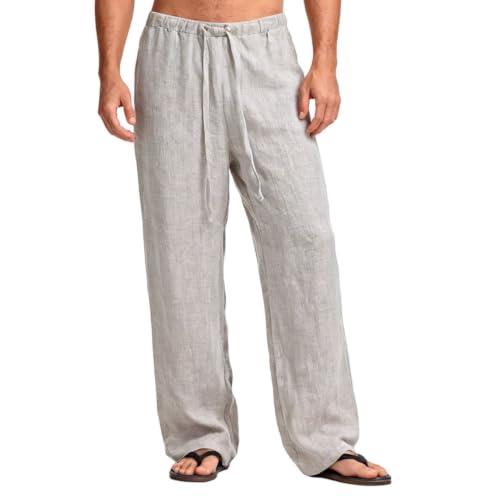
With Amazhiyu Men’s Pure Linen Loose Drawstring Pants, identify whether the difficulty lies in the adjustable waist or the nonadjustable dimensions below it. A drawstring can change how the waist is secured, but it cannot replace missing rise or leg length. Assess the actual dimensions before deciding whether an alteration could help.
Gentle reshaping has a narrow role
If the label permits a wet-care method that includes reshaping, it may be reasonable to restore the garment’s intended alignment during that process. This means smoothing and arranging, not suspending weights from the hems or pulling opposite ends until the seams resist. Follow the complete care instruction rather than adding a soak solely because a generic internet recipe recommends it.
Stop when the fabric resists, a seam begins to distort or different sections respond unevenly. A visual improvement while wet is not proof of lasting recovery after the pair is ready to wear. Document the result under the same conditions as your original comparison. Repeated treatments can consume time without telling you whether you have achieved a usable, stable fit.
A hair conditioner recipe gives you no dependable target for restoring a trouser’s original dimensions. Treat another bath as a new intervention, with its own compatibility questions for the fabric, color and components. If the garment is valuable or has a lining problem, take the untreated pair to a qualified cleaner or tailor before adding a substance that creates another issue to diagnose.
What a tailor can inspect that a home stretch cannot
A hem may contain extra fabric that can be released, but the available amount depends on the actual construction. A tailor can open or inspect it and explain whether a longer finish is possible, whether an old fold will show, and whether the revised hem would look deliberate. Do not assume every pair hides enough allowance for your target length.
Side seams, the center-back seam and waistband construction may offer different possibilities for width adjustments. An elastic channel is a different project from a structured fixed waistband. Existing pockets, belt loops, fasteners and seam finishes affect access. Ask which measurement the proposed alteration would change and which restrictions would remain afterward.
Take your usual shoes and describe the intended use. A solution that looks acceptable standing at a fitting may still leave insufficient seated room. The waist alteration guide and hem planning guide explain those separate decisions. A tailor’s inspection can establish options; this article cannot infer seam allowances from a product photograph.
Hooever Women’s Button-Up Cotton Linen Wide-Leg Pants direct attention to the closure and trouser structure. If the button area now pulls, do not compensate by yanking the legs longer and assume the whole fit has recovered. Have the relevant dimension and construction inspected. The title establishes a cotton-linen description, not the size of any usable seam allowance.
Decide between repair, a new role and replacement
Compare the likely result with the fit you need. If a tailor can release a suitable hem while preserving the rest of the garment, that may be a straightforward way to regain practical use. If several dimensions are too small and the construction offers little allowance, a collection of compromises may cost more effort than it returns.
A new role should be intentional. You might choose a cropped silhouette for a pair whose upper fit remains comfortable, or use trousers more casually if the hem finish changes. Do not keep forcing a restricted seat or waistband because the fabric otherwise looks attractive. Comfort and movement remain valid requirements after a repair.
For a future purchase, save the lessons that are actually supported: the process used, the observed change and any manufacturer response. Do not turn one accident into a universal judgment about all pure linen or every product from a brand. The separate shrinkage prevention guide covers baseline records and first-care planning so the next pair begins with better information.
Tallemon Men’s Tall Straight Linen Pants illustrate why a length-dependent purchase needs a precise outcome. A pair chosen for tall proportions may be unusable to its owner even when the visual difference looks modest to someone else. Evaluate against your required inseam and rise, not another shopper’s tolerance for a shorter hem. None of these listings promises reversible shrinkage.
FAQs
Will wearing the trousers while wet stretch them back?
That is not a controlled restoration method, and it can load seams and restricted areas unevenly. Use a measured assessment and any label-permitted reshaping process instead. If the seat or rise is too tight, a tailor can explain whether construction allows a useful change.
Can a tailor add length without making the trousers wider?
Possibly, if the hem contains suitable usable fabric or another acceptable construction change is possible. Length and width are separate alteration questions. An inspection is needed to establish the allowance, the appearance of an old fold and the finished result.
Is slight improvement after steaming proof the shrinkage is fixed?
No. Compare the garment after it has reached its normal ready-to-wear condition, using the same measurements and try-on conditions. A temporary change in arrangement or feel is not a guarantee that the original dimensions have been restored.
Final Verdict
Treat shrunken trousers as an assessment problem before treating them as a rescue project. Confirm the loss, define the fit you need and ask what the existing construction can supply. Gentle alignment may correct distortion; a tailor may reclaim useful allowance. Neither supports a promise that every shortened or tightened pair can become its original size again.