The hips finally fit. The seat feels comfortable, the pockets stay where you want them, and then the waistband stands away from your back. Buying the smaller size may remove the gap while taking away the room that made the trousers promising in the first place.
A waist gap is a relationship problem between dimensions, not evidence that your body needs to match a standard shape. This guide helps you preserve a successful hip fit while deciding whether adjustment, a different waistband pattern or an alteration is the sensible next step. The same issue can occur across many clothing sizes.
Quick Answer
When linen pants fit the hips but gap at the waist, keep the comfortable hip measurement as your starting point. Check the waistband’s intended position, then compare a more suitable waist-to-hip relationship, an adjustable closure or a feasible alteration. Sizing down works only if the hips, seat and thighs still have enough room. A belt can manage a small adjustment, but heavy gathering may signal a different cut is needed.
As an Amazon Associate I earn from qualifying purchases.
Confirm that the gap exists at the intended wearing position
Before choosing a remedy, loosen any drawstring and settle the trousers where their rise works naturally. A waistband worn higher than intended may meet a smaller body circumference and appear too large. One worn lower can change the seat and crotch position in the other direction. You can prefer either placement, but the garment must still function there. If moving the waistband removes one issue while creating another, compare a rise designed for your preferred position.
Check the gap standing and sitting, at the front and back. A small opening at one position may behave differently from a band that is loose all the way around. Note whether the waist moves down, whether the rear band catches on a top, or whether the issue is purely the appearance you see in a mirror. These distinctions help you choose a proportionate response instead of treating every visible space as a tailoring emergency.
Preserve the part of the pattern that works
Make a short record of the successful fit: comfortable seated hip, enough upper-thigh room, desired leg shape and satisfactory rise. These are requirements for the next pair as well as observations about the current one. If a smaller size removes them, it has not solved the overall fit. It has exchanged a waistband mismatch for a restriction elsewhere.
A fictional example makes the logic clear. Suppose the current pair sits smoothly over the hips but leaves excess waist fabric, while the next size down closes neatly and pulls across the seat when you sit. The second pair is not the better size merely because the waist looks tidier. The useful comparison is a garment with a smaller waist relative to its hip allowance, or a construction that can adjust the waist without removing necessary room below it.
Distinguish adjustment from reshaping
A drawstring reduces the effective waist opening by gathering fabric. Elastic provides a changing opening within its usable range. A contoured waistband is shaped to follow a different line than a simple straight band. These mechanisms address the waist differently, and a product’s title may not reveal all of them. Do not assume a high-waist label means a contoured waistband or that “curvy” wording establishes a particular waist-to-hip measurement.
If your mismatch is modest and you like a gathered look, a working drawstring may provide the adjustment you want. If you want a smooth, tailored waist above fuller hips, more gathered fabric may be aesthetically unsatisfying even when it holds the trousers up. In that case, seek clearer pattern dimensions or ask a tailor about the existing construction. The desired finish matters alongside the amount of adjustment needed.
Use the verified models to compare mechanisms
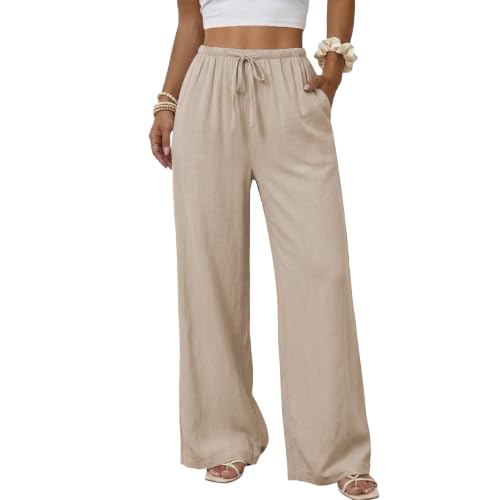
The Duyang Women’s Cotton Linen Drawstring Palazzo Pants title lists both an elastic waist and a drawstring, with a wide-leg shape. That makes it an example of adjustable gathered-waist construction to investigate. It does not establish the band’s relaxed or extended dimensions, nor how much gathering you would need. Check those details against the selected size rather than treating the dual closure as an automatic waist-gap cure.
The Hooever Women’s Button Up Cotton Linen Trousers title describes a button-up, high-waisted, wide-leg style. Its title does not establish that the waistband is contoured or that it has hidden elastic. The Cali1850 Women’s Smocked Waist Linen Pants listing explicitly includes smocked waist and drawstring wording. These are three useful construction starting points, not verified rankings of which fits a particular waist-to-hip difference best.
Test a drawstring without tightening away the diagnosis
Adjust the cord gradually to the point where the waistband stays where you want it. Look at where the gathers accumulate. If they bunch mainly at the front, distort a pocket or create an uncomfortable knot under a top, the adjustment has a cost you need to consider. A cord that can be pulled tighter is not necessarily a reason to keep tightening it. The purpose is comfortable support, not reducing the waist to the smallest opening possible.
Sit and stand with the cord tied as you would actually use it. If you must retie it for every change of position, the underlying size or rise may still be a poor match. Also check whether the hip and seat remain relaxed once the waist is secured. A successful adjustable pair should preserve the fit you liked below the band rather than pulling that fabric upward into a new tension pattern.
Know what a belt can and cannot contribute
A belt can fine-tune a waistband that is only a little larger than you prefer, provided the garment has suitable loops and you like the resulting shape. Check that the loops are actually present on the selected product; they are not implied by a button closure. When substantial fabric folds under a tightly cinched belt, the belt is holding the extra circumference rather than removing it. You may accept that appearance, but it is a distinct outcome from a smoothly fitted waist.
Without belt loops, do not assume an ordinary belt will stay in a useful position over loose linen. And do not mistake a styling belt worn over a top for structural support for the pants beneath it. If you want the trousers to work without a belt, evaluate them that way before deciding. A purchase that only succeeds with an accessory you dislike may not be the right garment for your routine.
Bring a precise question to a tailor
If you already own the pants and the hip fit is valuable, ask whether the waist can be reduced while preserving the seat, pockets and closure. The answer depends on seams, waistband construction, elastic access and the amount of change. A gathered waistband may need different work from a fixed band. There is no universal alteration method or guaranteed invisible result for every linen trouser.
Wear the pants at your intended height for the assessment and explain which parts you want unchanged. A useful question is “Can this excess waist be reduced without changing the comfortable hip fit?” rather than simply asking for a smaller size. The waist-alteration guide covers construction feasibility in more detail. This guide’s job is to establish why an alteration might be worth investigating, not to prescribe a sewing operation without seeing the garment.
Improve the next search with a ratio problem, not a body label
When shopping again, compare the listing’s waist and hip measurements together using the same measurement convention. A garment chart may reveal a different relationship between those dimensions even when the size labels are similar. If the information is missing, ask for the actual dimensions for the selected size. Marketing words such as curvy, relaxed or flattering cannot supply the missing numbers.
Keep your preferred rise in the comparison. The body circumference where a lower waistband sits differs from the circumference at a higher position, so a change of rise can alter the size relationship you are evaluating. For the method of collecting comparable numbers, use the measurement guide; for the placement decision, use the rise comparison. Those two inputs help you identify a genuinely different candidate instead of repeating the same mismatch across brands.
FAQs
Is a waist gap only a plus-size fit problem?
No. It can occur at many sizes whenever the garment’s waist-to-hip relationship differs from the wearer’s needs at the chosen position. Size range and proportion are separate issues. Preserve the actual comfortable hip fit rather than assuming a category label explains the cause.
Can high-waisted linen pants still gap at the back?
Yes. High waist describes intended placement, not a guarantee that the band matches your waist shape or circumference. Check the garment dimensions and construction. Moving the waist higher can expose a different circumference relationship, so judge the fit at the position you intend to wear.
Should I immediately take in every visible gap?
No. First decide whether it affects support, comfort, coverage or the appearance you want. A small space that disappears or changes while seated may not require intervention. If alteration is still worthwhile, have the actual construction assessed before assuming how the excess should be removed.
Final Verdict
Keep the hip fit you worked to find. Use modest adjustment when it feels and looks right, seek a different waist-to-hip relationship when cinching distorts the trousers, and investigate tailoring when an otherwise successful owned pair deserves it. Sizing down is only a solution when the rest of the garment remains comfortably usable.
Explore the relevant collections
Continue reading
- How to Measure for Linen Pants Online
- Plus-Size Linen Pants: Fit Beyond the Waist
- High, Mid or Low Rise in Linen Pants?
- Can a Tailor Alter Linen Pants at the Waist?